Designing Sprinklers for Large Rural Yards on a Well
On a well and tired of dragging hoses? Learn how to design and stage an efficient sprinkler system for large rural yards while protecting your water supply.
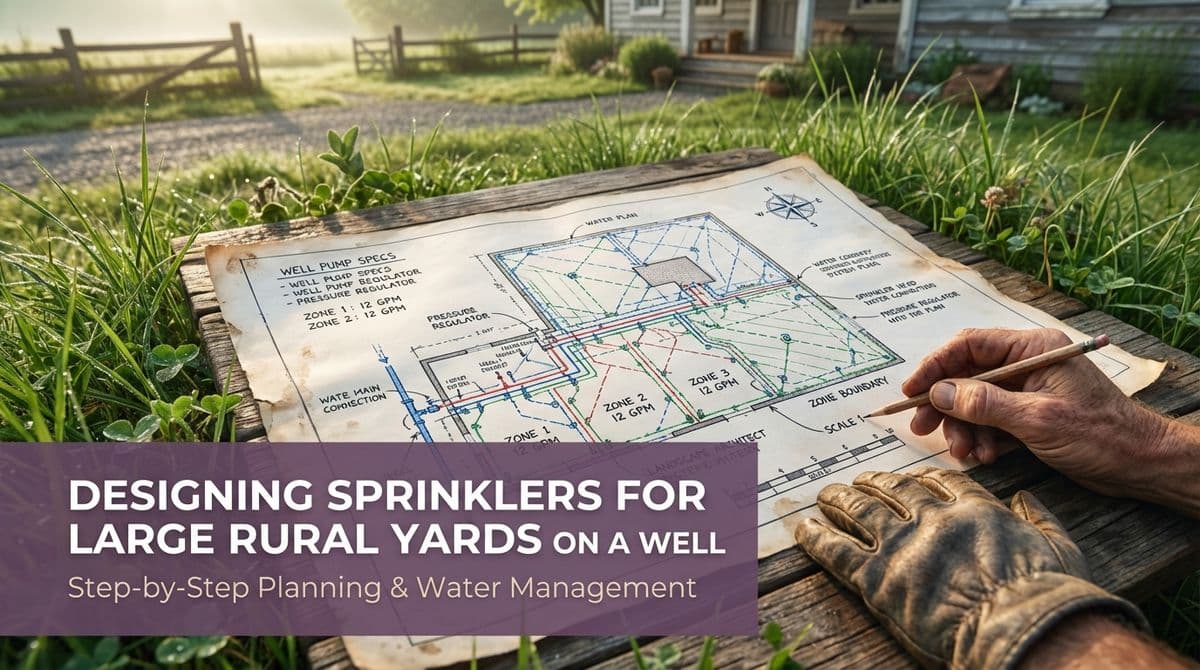
Planning a Sprinkler System on a Well-Fed, Two-Acre Property
We recently got a call from a customer — let's call her Jenny — who had just bought a “diamond in the rough” on about two and a half acres out in the country. She told us she spent last summer dragging hoses all over a big backyard and finally decided, “I don’t want to do that anymore.”
Like a lot of rural homeowners, Jenny is on a well, has almost no existing landscaping, and wants to do things in stages over several years. She already had an ambitious landscape design on paper, but it felt overwhelming and she needed a realistic, step-by-step plan to get an efficient sprinkler system in the ground without overtaxing her well or her budget.
If that sounds familiar, this post will walk you through how we plan, stage, and manage water for large rural yards on wells — the same way we talked it through with Jenny before we ever set foot on her property.
Step 1: Start With the Well, Not the Sprinkler Heads
The most important part of an efficient irrigation system on a rural property isn’t the sprinkler layout — it’s the water source. When Jenny mentioned she was on a well, that immediately changed how we approached the design.
On a municipal system, you usually have plenty of pressure and volume. On a well, you have to design around what the pump and pressure tank can actually deliver without short-cycling or running the well dry.
Key checks before you design anything
- Measure static and dynamic pressure: We like to test the pressure at a hose bib with no water running (static) and then with several fixtures flowing (dynamic). That tells us how many zones we can safely run.
- Estimate usable flow (GPM): A simple bucket test can give a rough gallons-per-minute figure. For a 5-gallon bucket, timing the fill and doing the math is enough for planning.
- Confirm well and pump details: Depth of the well, pump size, and tank size help us avoid designs that cause rapid pump cycling or over-pumping.
Homeowner tip: If you’re not sure about your well’s capacity, don’t guess. A short visit from an irrigation pro or well contractor to test pressure and flow will save you money and headaches down the road.
Step 2: Break the Property Into Logical Irrigation Zones
When Jenny said she wanted to “do things in stages,” that was actually great news. Large rural yards work best when you plan the whole property on paper, then build it in phases. That way, you’re not tearing up finished areas later to add pipes or valves.
How we typically divide a 2–3 acre property
- High-priority turf areas: For Jenny, this was the big backyard lawn she wanted green and usable soon.
- Future lawn or pasture: Areas that may be seeded later can be pre-planned for irrigation but installed in a later phase.
- Planting beds and trees: These often get drip irrigation instead of sprays or rotors.
- Low-priority or natural areas: Sometimes these don’t need irrigation at all.
We’ll typically sketch a full-site irrigation plan, then highlight phase 1 (in Jenny’s case, the large backyard), phase 2 (front yard or side yard), and so on. Even if you only install phase 1 now, the mainlines, valve locations, and controller capacity are chosen with all future phases in mind.
Step 3: Match Sprinkler Types to the Size and Shape of Each Area
On small city lots, you can sometimes get away with one type of sprinkler everywhere. On a couple of acres, that wastes water and stresses your well. For Jenny’s large backyard, we talked about using gear-driven rotors instead of little fixed spray heads.
When to use rotors vs. sprays vs. drip
- Rotors: Best for big, open lawns (back acres, large backyards). They throw water farther and apply it more slowly, which helps when you’re limited on flow.
- Spray heads: Better for small or narrow areas where you need tighter coverage but don’t have the space for rotor throw distances.
- Drip irrigation: Ideal for trees, shrubs, and beds, especially on a well. Drip is efficient and gentle on marginal water supplies.
The key is to never mix different head types in the same zone. Rotors, sprays, and drip all apply water at different rates, so they need their own zones and run times.
Step 4: Zone Design Around Your Well’s Capacity
Once we know the well’s usable GPM and pressure, we size zones so they never ask more from the well than it can comfortably deliver. For example, if we measure 10–12 GPM available, we might design rotor zones that only draw 7–8 GPM to build in a safety margin.
Practical zone-planning tips for wells
- Fewer heads per zone: Don’t max out the math on paper; real-world conditions vary.
- More zones with shorter run times: It’s better for the pump and gives you finer control.
- Separate “critical” from “optional” areas: Lawns and gardens can be on higher-priority schedules; low-use areas can be on reduced or occasional watering.
For Jenny’s property, that meant focusing the first set of valves and lateral lines on the backyard lawn and leaving room in the valve box and mainline for future front and side yard zones.
Step 5: Smart Staging So You’re Not Re‑Doing Work Later
Because Jenny knew this project “would probably take years,” we spent extra time on staging. Even if you’re only installing sprinklers in one area now, there are a few smart moves that make later phases easier and cheaper.
What to do in phase 1 (even for future phases)
- Install an adequately sized mainline from the well/house to a central valve location sized for the eventual system.
- Set a controller with expansion capacity (more stations than you need on day one).
- Stub out capped tees on the mainline toward future zones so you don’t dig up finished lawn later.
- Place valve boxes where they can serve multiple phases, not just the first area.
This is exactly how we approached Jenny’s job: lock in the backyard lawn now, but build the backbone for the rest of the property while the trenching equipment is already on site.
Step 6: Dial In Water Management and Scheduling
Design is only half the battle; on a well, run times and schedules matter just as much. A well-designed system can still waste water or stress your pump if it’s run incorrectly.
Watering wisely on a well
- Water early in the morning: Cooler temps, less wind, and more consistent pressure.
- Cycle and soak: Instead of one long run that causes runoff, break it into two or three shorter cycles.
- Use seasonal adjustments: Many controllers let you reduce all run times in spring/fall and increase in peak summer without reprogramming everything.
- Consider a rain or soil moisture sensor: These are great tools for avoiding unnecessary watering.
For large rural lawns, we often recommend a controller that can handle multiple start times and programs, so turf, beds, and low-priority zones can all be managed differently without constant reprogramming.
Step 7: Know When to Call in Help
Jenny did exactly what we wish more rural homeowners would do: she got a landscape plan, realized it felt overwhelming, and then called to talk through a realistic, staged approach. That conversation let us shape a system that respects her well, her budget, and her long-term vision.
If you’re sitting on a big, mostly bare property, dragging hoses around and wondering how to start, the next best step is usually a site visit and flow/pressure test. From there, we can map out a phased irrigation plan so you get out of hose-hauling season for good — without putting your well at risk.