Designing a Narrow Side Yard with Walls, Fence & Pavers
Got a cramped side yard with a failing wall and fence? Learn how we design narrow spaces using retaining walls, fencing, and paver paths that actually work together.
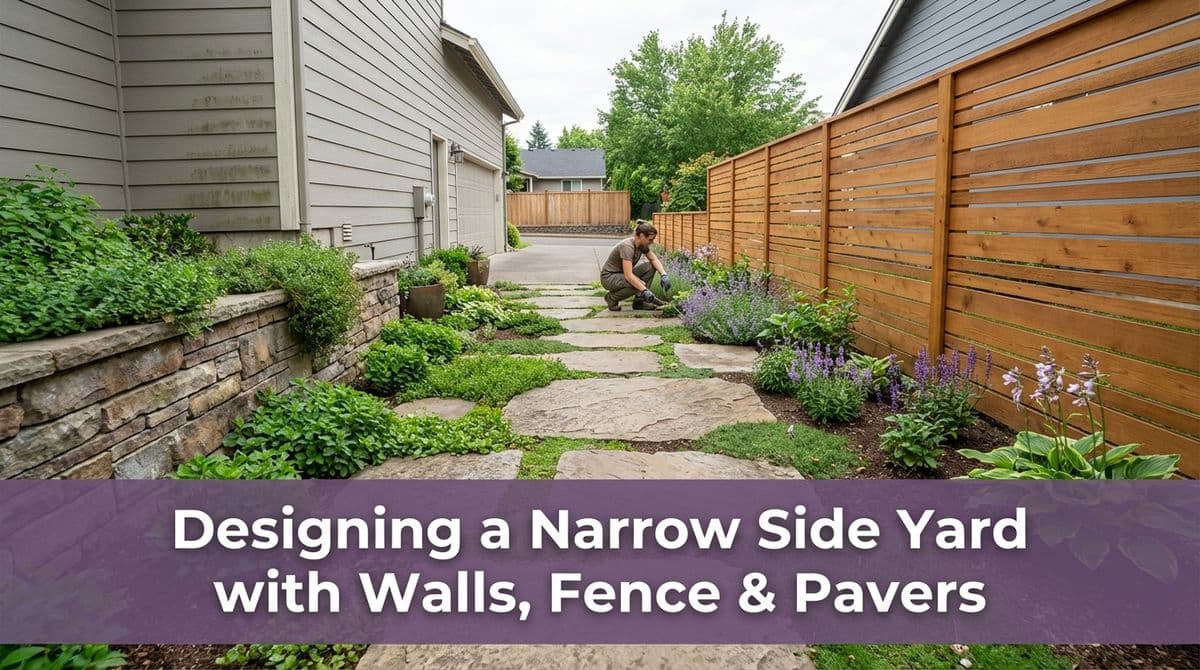
A Narrow Side Yard Call That Got Us Thinking
We recently got a call from a customer — let's call her Linda — about a tight little side yard on the west side of her rental house. The space was only about five feet wide between the house and the fence. There was a skinny, uneven walkway, a semi-falling-down fence, and an old, low concrete block wall that had definitely seen better days.
Linda wanted to pull everything out and start fresh: a slightly taller retaining wall that actually looked nice, a new fence on top of it, and a simple paver path to match the one-foot-square pavers on the patio at the back of the house. At the end of the run, the wall turned and continued as a low curb that held back soil under a noble fir where the ground sloped. She was hoping we could raise that curb wall by a block or two to stabilize the soil and make the whole area feel more cohesive.
As we talked through options with Linda, we realized her questions are the same ones a lot of homeowners have about narrow side yards. So we figured we’d walk through how we think about combining retaining walls, fencing, and paver paths in tight spaces like this.
Step One: Decide What the Side Yard Really Needs to Do
Before talking materials or colors, we always start with function. With Linda, we asked a few key questions:
- Is this mainly a passageway for tenants to get from front to back?
- Do you need storage (garbage cans, bikes, yard tools) along one side?
- Are you fighting erosion or soil slumping from a higher area?
- How important is privacy and security from the neighboring property?
In her case, the side yard was essentially a service corridor: tenants needed a safe, comfortable path, and the small “forested” area at the end needed better soil retention. Privacy mattered, but she didn’t want the space to feel like a dark tunnel either.
Once we’re clear on function, it becomes much easier to size the wall, place the fence, and choose the paver layout.
Designing the Retaining Wall in a Tight Strip
Linda’s existing wall was a short, old concrete block edge that wasn’t doing much structurally or visually. She wanted something a bit taller that matched better and tied into the curb around the sloped area under the tree.
In narrow side yards, retaining walls do double duty: they hold back soil and visually define the space. A few things we always consider:
- Wall height and safety: Even a “little teeny wall” can be structural. Above a certain height, you may need engineering or specific construction methods. That’s one reason we talked about our coming out to measure and verify the wall height on site.
- Block type: Pre-formed interlocking retaining wall blocks (the kind Linda already had) are great for low walls and small height increases—like raising an existing curb by one or two courses to better hold sloped soil.
- Drainage: Any retaining wall needs drainage behind it so water doesn’t build pressure and push it over. In a tight space, that usually means compacted gravel backfill and a perforated drain pipe leading to a safe outlet.
For her “little forested area,” our goal was to keep the soil in place around the noble fir without creating a bulky wall that ate up walkway space. Matching the block style and color across both the side-yard wall and the curved curb area helps the whole backyard feel intentional instead of patched together.
Putting a Fence on Top of a Retaining Wall
Linda’s fence was leaning and tired, and she really liked the idea of a new fence sitting on top of the new wall to gain a bit of height without making the yard feel cramped.
There are a few smart ways to combine fences and retaining walls in tight side yards:
- Posts set behind the wall: One common method is to build the retaining wall and then set fence posts in concrete just behind it, so the fence sits slightly inboard. This is often the most durable approach.
- Posts integrated with the wall: Some systems allow for posts to be mounted to the wall with brackets or sleeves, but that usually requires the wall to be designed for the load from the start.
- Height balance: In a five-foot-wide space, we typically suggest a modest wall with a standard-height fence, rather than a very tall fence right off grade, so the area doesn’t feel like a vertical shaft.
One important note we always mention: local codes may have rules about combined wall + fence heights and how close structures can be to property lines. It’s worth checking those before you commit to a design.
Choosing and Laying a Paver Path That Actually Fits
Linda wanted the path to match the simple one-by-one-foot pavers on the patio at the back of the house so everything felt like one continuous outdoor space. In narrow side yards, matching or complementing existing materials is one of the easiest ways to make everything feel cohesive.
Here’s how we usually approach paver paths in tight spaces:
- Path width: In a five-foot-wide strip, we like to keep at least 30–36 inches of clear walking space. The remaining width can be used for the wall, fence line, or a shallow planting strip.
- Pattern choice: Square pavers in a simple grid or running bond pattern work well and minimize cuts in tight areas. Matching the patio pattern, as Linda requested, makes transitions feel natural.
- Base prep: We always excavate enough for a compacted gravel base and a sand setting bed. In side yards that stay damp, a solid base is critical so the path doesn’t heave or sink over time.
Because her tenants would be using the space regularly (and because Portland-style rain makes things slick), we also talked about choosing a textured paver with decent traction rather than a very smooth surface.
Making a Small, “Yucky” Side Yard Feel Cohesive
Linda joked that it was “only a teeny little” space and pretty “yucky,” but she really wanted to make it more comfortable and safe for her tenants—without blowing the budget. That balance between function and form is exactly where tight side yards can shine.
Here are a few principles we lean on in designs like hers:
- Keep materials simple: One wall block style, one paver style, and a fence color that complements the house. Fewer materials usually look more polished in narrow spaces.
- Think in straight, clean lines: In a tight corridor, extra jogs and curves just steal usable space and complicate construction.
- Tie transitions together: Where Linda’s low curb wall met the side-yard wall, we looked at raising it slightly and using the same block so the change in height felt intentional.
- Plan for maintenance: Make sure there’s still enough room to walk a wheelbarrow through, move trash bins, and access siding, windows, or utilities along the house.
When those pieces come together—a stable retaining wall, a solid fence, and a comfortable paver path—the narrow “forgotten” side of a house can turn into a clean, functional passageway that tenants and homeowners actually appreciate.
If you’re staring at your own five-foot-wide gap between house and fence, wondering how to fix the leaning wall, the sagging fence, and the uneven path all at once, you’re not alone. We’re always happy to walk that space with you, talk through function versus form, and help you turn a cramped strip into something safe, cohesive, and easy to live with.