DIY or Pro? Retaining Walls for Sloped Driveways & Yards
Thinking about DIYing a retaining wall to level a sloped driveway or yard? Learn when it’s safe to tackle yourself and when you really need a pro.
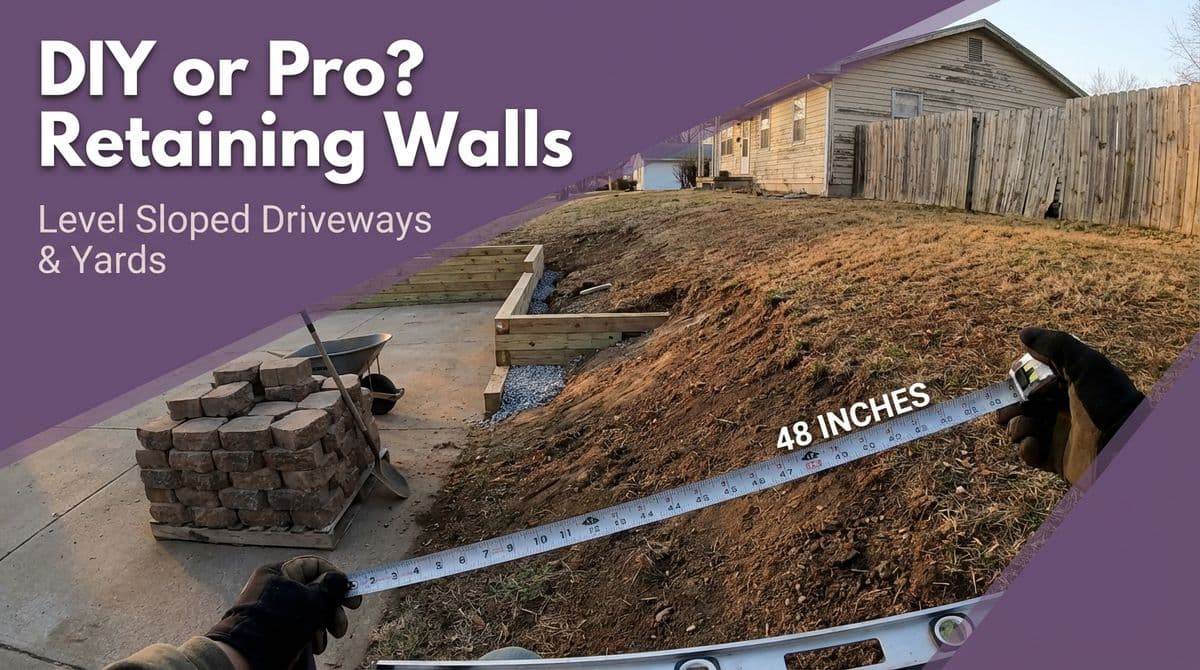
“We Can Do It Ourselves… Right?”
We recently got a call from a homeowner’s dad — let’s call him Gary — who was in the middle of a big retaining wall project. Gary had already dug out about 100 feet along a sloped driveway and backyard. His goal was to come up about 22 inches to create parking space in the drive and flatten out part of the yard in back.
By the time he called us, Gary was at what he called “a juncture” — deciding whether to finish the wall himself or bring in a pro. He and his son are both pretty handy and budget-conscious, but his son is a busy dad with three kids and not much spare time. Gary told us, “I’ve got more money than back… and I’m losing interest in doing this myself.”
If that sounds familiar, this post is for you. Using Gary’s project as a guide, we’ll walk through how to safely level a sloped driveway or yard with a retaining wall — and how to decide whether DIY or hiring a pro makes more sense.
First Question: What Is the Wall Actually Holding?
One of the first things we asked Gary was what the wall would be supporting. In his case, part of the wall needed to hold up a driveway where a truck would be parked, and the rest would help level out a backyard slope.
That matters because of something called surcharge — the extra weight pushing on the wall from what’s behind or on top of it.
- Driveway or parking area: This is a high-surcharge situation. Vehicles add a lot of weight, so we almost always recommend a substantial, engineered block system and proper drainage. Cutting corners here can lead to wall failure and serious safety hazards.
- Simple garden bed or light landscaping: Much lower surcharge. In those cases, we can sometimes use smaller, ornamental blocks or even timber in the right conditions.
For Gary’s project, we told him we’d want to use a heavier-duty block where the driveway is involved and then evaluate whether the backyard portion could be built more lightly, depending on slopes and soil conditions.
DIY Retaining Walls: When They Make Sense
Gary had already done a lot of prep work — he had the area dug out, and he’d even called in utility locates so he knew where two electrical lines ran. For some homeowners, that kind of head start makes DIY appealing.
Here are situations where tackling a wall yourself can make sense:
- Height under 2 feet with no vehicles or structures directly behind it.
- No surcharge from driveways, sheds, or slopes stacking above the wall.
- Good access for moving block, gravel, and tools by hand or with a small machine.
- Time and physical ability to move hundreds (sometimes thousands) of pounds of material.
If those fit your situation, a DIY retaining wall can be a solid weekend-warrior project. Just make sure you:
- Start with a properly compacted, level base of crushed rock.
- Use wall block designed for retaining, not just decorative edging.
- Install drain rock and a perforated drain pipe behind the wall where needed.
- Step back and stagger courses so joints don’t line up.
Even on simple projects, a few early mistakes in layout or base prep can haunt you later, so we always encourage homeowners to overdo it on the foundation rather than underdo it.
When You Really Should Hire a Pro
With Gary, the deciding factor wasn’t just difficulty — it was risk. Supporting a truck on a leveled driveway with a 22-inch wall along 100 feet of slope means there’s a lot of weight involved over a long distance.
Here are some clear signs that bringing in a professional is the safer call:
- Driveways or parking pads above or behind the wall.
- Walls over 3–4 feet in height (many areas require engineering or permits at this point).
- Steep slopes above or below the wall that could slip or erode.
- Unknown soil conditions (soft, saturated, expansive, or loose fill).
- Utilities, easements, or property lines that complicate layout.
Gary had already done his utility locates and knew there was an easement where he wanted to build. That’s another place where professional help matters. We always review local codes, setbacks, and easement rules before we design or build, because moving a wall later is a lot more expensive than planning it correctly the first time.
Hidden Costs DIY Builders Often Miss
Gary’s son was “on the fence” about spending the money. That’s completely understandable — block, gravel, and labor add up. But DIY projects have hidden costs too, especially on larger walls.
Here are a few line items many homeowners underestimate:
- Base and drainage stone (usually more volume than people expect).
- Compaction equipment rental (plate compactor or jumping jack).
- Delivery fees for block and rock if you don’t have a large truck or trailer.
- Correction work if the first attempt settles, leans, or fails.
- Your time and your back — moving each block multiple times adds up.
On projects like Gary’s, we’ll often walk the site and give two perspectives: what a safe, code-compliant professional build looks like, and what a realistic DIY scope might be. Sometimes the best answer is a hybrid — homeowners handle demo and some prep, and we come in for base, block, and drainage.
How We Help Homeowners Decide
With Gary, we set up a time to meet him and his son together so everyone could hear the same options and pricing. That way, we could walk the driveway and backyard, look at slopes and soil, and talk frankly about:
- Where we’d recommend heavier-duty block and engineering.
- Where a simpler treatment or shorter wall might be safe and cost-effective.
- How to stay within property lines and respect easements and utilities.
- What pieces, if any, they might still want to DIY.
We always tell folks: our job is to help you get a safe, long-lasting wall — whether that means we do the whole thing, just the critical parts, or you decide DIY truly is enough.
Thinking About Leveling Your Own Slope?
If you’re looking at a sloped driveway or backyard and wondering whether to build the retaining wall yourself or call in help, start by asking:
- What exactly will be sitting on or behind this wall?
- How high will it be at the tallest point?
- Are there utilities, easements, or property lines nearby?
- Do we have the time, tools, and strength to do it right?
Once you’ve answered those, it’s much easier to see whether DIY is a smart move or an accident waiting to happen. And if you’re still unsure, we’re always happy to walk the site with you, talk through options, and help you choose the safest, most cost-effective path for your project.